Vedic Maths is a collection of ancient mathematical principles and techniques discovered in the Vedas (the Indian scriptures mainly from Atharva Veda). Jagadguru Sri Bharathi Krishna Tirthaji rediscovered it between 1911 and 1918.
Vedic mathematics offers a unique approach to solving numerical problems quickly. These techniques are most valuable for students, Professionals, and maths geeks.
Starting Point of Vedic Maths
Bharati Krishna Tirtha was born in March 1884 in Puri Village, Orissa (India). In addition to mathematics, he also learned Science, humanities, and Sanskrit subjects. He was passionate about meditation and spiritualism. He gained knowledge of the Vedic Sutras during eight years of meditation in a forest near Sringeri. According to Krishna Tirtha, he learned the sutras from the Vedas, such as the Atharva Veda and the Rig Veda, hence he named it as ‘Vedic Mathematics.’
What Are Vedic Maths Formulas?
Vedica (or Vedic) Maths is based on 16 sutras (principles) and 13 sub-sutras derived from ancient Indian texts. These are not complex theories — they’re smart shortcuts to solve arithmetic, algebra, and even geometry problems faster.
Think of them as:
- Time-savers during exams
- Confidence boosters for kids
- Mental maths techniques useful everywhere — from shopping to budgeting
And the best part? Anyone can learn them.
Why Vedic Maths Matters Today
ven in the world of calculators and apps, mental math skills are still important. Vedica Maths improves:
- Calculation speed
- Accuracy
- Memory & focus
- Logical thinking
- Confidence in numbers
That’s why schools, coaching centers, and competitive exam aspirants rely on these sutras.
Core Vedic Maths Formulas (Explained Simply)
Below are some of the most powerful sutras, written in simple language with examples so you can actually use them.
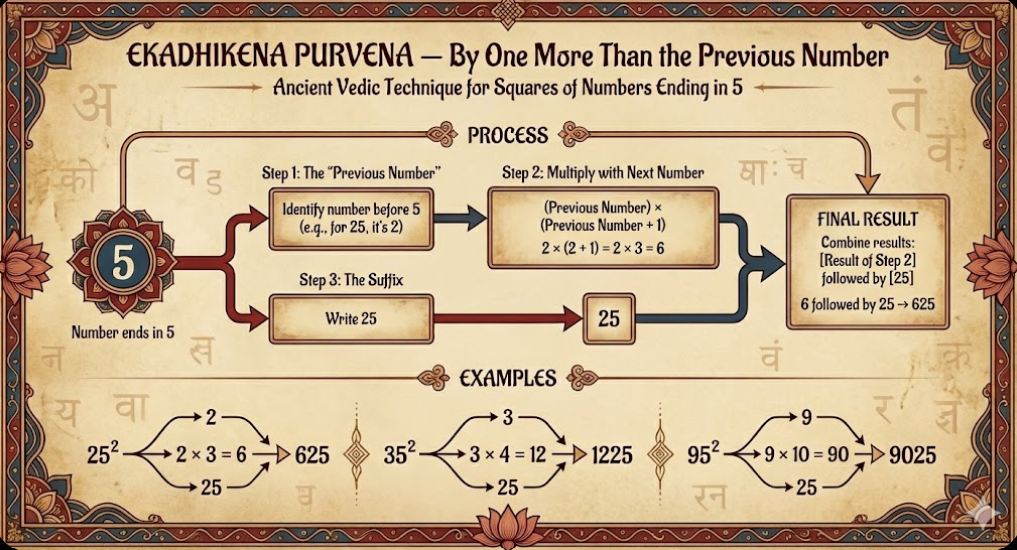
1️⃣ Ekadhikena Purvena — “By One More Than the Previous Number”
One of the most popular sutras — used for squares of numbers ending with 5. Check the below image for
How it works:
Take the number before 5 → multiply it with its next number → then write 25.